Drone thermal inspection for roofs and solar arrays
Radiometric drone thermography that finds wet roof insulation and underperforming solar modules, delivered as measured findings your roofer or O&M team can act on.
Get a quoteBased in Fauquier County. Flying commercial roofs and solar sites across Virginia.
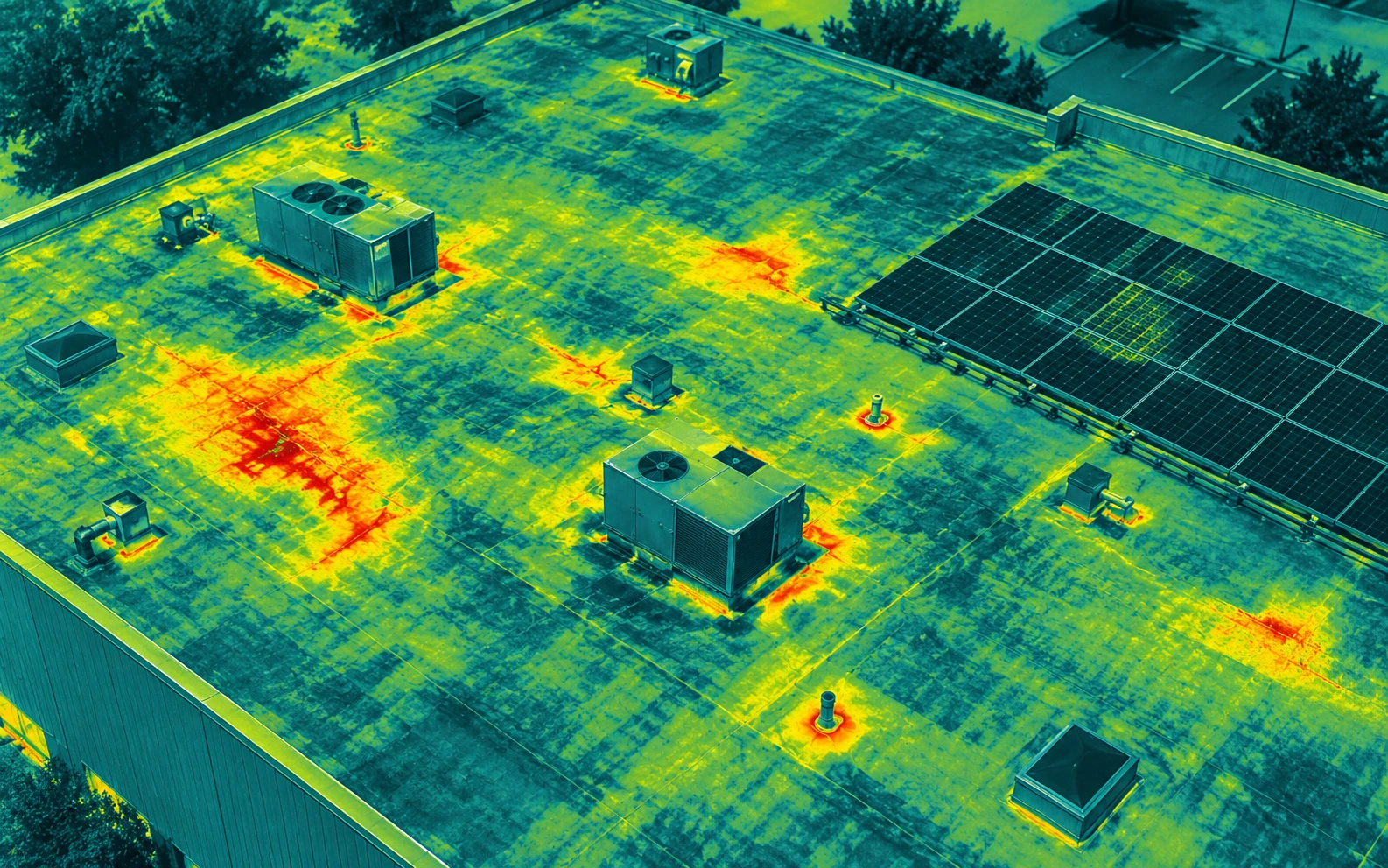
What a drone thermal inspection delivers
Findings located precisely enough that someone can walk straight to them.
Roof moisture map
Georeferenced boundaries of suspected wet insulation, with the area of each in square feet, as a PDF and as CAD or GIS files.
Recommended core locations
Where your roofer or consultant should core to verify each area before scoping repairs.
Solar defect report
Module-level faults classified by type and severity, with measured temperature differences, reported against IEC 62446-3.
Georeferenced defect map
Every faulty module located on an orthomosaic of the array, ready for your O&M team.
Radiometric imagery
Thermal images that carry a temperature at every pixel, so any finding can be measured and rechecked.
Close-up visual documentation
Zoomed photos of flashing, seams, penetrations, and physical module damage.
How a drone thermal inspection runs
Thermal work depends on conditions more than anything else, so scheduling is part of the service.
- First call
Scope
Roof assembly and size, or array capacity and layout, plus warranty status and what the results need to support.
- Scheduling
Wait for conditions
Roofs are flown one to three hours after sunset following a clear, sunny day. Solar is flown at clear midday with strong sunlight.
- Flight
Fly
Radiometric thermal and visual imagery collected together in a single flight.
- Delivery
Analyze
Findings measured, classified, located, and delivered with guidance on verification.
Who uses drone thermal inspection
Facility and property managers
Scope roof repairs before replacing a whole roof, and build moisture data into capital planning.
Roofing consultants and contractors
Wet areas as coordinates you can navigate to, so coring goes to the right spot the first time.
Solar owners, O&M providers, and EPC teams
Module-level findings for technician dispatch, warranty claims before they expire, production recovery, and commissioning acceptance.
What a roof moisture survey finds, and what it doesn't
A thermal survey maps wet insulation. It doesn't see the leak itself. Water enters at a seam, flashing, or penetration and travels before it soaks in, so the wet area can sit some distance from the entry point.
What the survey does is shrink a 40,000 square foot mystery down to a few specific areas. Cores confirm each one, and the report shows where to take them.
Thermal finds the anomaly. Technicians find the cause.
On a solar array, a drone solar inspection shows which modules run hotter than their neighbors and exactly where they sit, so a crew can walk straight to them. On a roof, it maps wet insulation for your roofer to core.
We locate and measure; we don't diagnose. Electrical diagnosis stays with the qualified technicians responsible for the array, and repairs stay with your roofer.
Questions about drone thermal inspection
Can a drone find a roof leak?
Not directly. A drone thermal survey maps areas of wet insulation beneath the membrane, which narrows the search dramatically. The entry point is often near a wet area's edge, but it has to be confirmed by a roofer on site.
What types of roofs can be surveyed with thermal imaging?
Low-slope commercial roofs with a membrane over insulation, including TPO, EPDM, PVC, and modified bitumen. Ballasted and gravel-surfaced roofs, and steep-slope shingle roofs, generally aren't good candidates.
When are drone thermal roof surveys done?
In the evening, one to three hours after sunset, following a clear and sunny day, on a calm, dry night. The roof surface needs a day or two to dry after rain.
What does a drone solar inspection look for?
Module-level temperature anomalies, such as hot cells, failed bypass diodes, disconnected strings, and soiling patterns, that set a module apart from its neighbors. Each finding is located on a map of the array so your team can inspect and test it.
When are drone solar inspections flown?
At clear midday with strong, steady sunlight, so temperature differences between modules are meaningful. We schedule around the forecast rather than fly a day that won't produce usable thermal contrast.
How much does a drone roof moisture survey cost?
Most commercial roof moisture surveys run $1,200 to $3,500, depending on roof area, number of roof sections, and deliverables. Portfolios of several buildings are priced per program.
How much does a drone solar panel inspection cost?
Solar inspections are usually priced per megawatt, commonly $300 to $500 per MW for community-scale sites, with lower rates for recurring annual programs.
What standard do you follow for solar thermography?
IEC 62446-3, the international standard for outdoor thermography of photovoltaic modules and plants. It sets the conditions, image resolution, and reporting that make results defensible to a manufacturer or insurer.
Is your thermal data radiometric?
Yes. Our 1280 by 1024 radiometric thermal camera records a temperature at every pixel, so each finding is a measured temperature difference rather than an impression from a colored image.
Do you diagnose the electrical cause of a solar hotspot?
No. We document, locate, and measure thermal anomalies. Electrical diagnosis and repair decisions belong to the qualified technicians maintaining the array.
Thermal inspection sites we serve
We inspect commercial roofs and solar arrays across Virginia, including Loudoun, Prince William, Fairfax, Fauquier, Stafford, Culpeper, and Spotsylvania counties, and travel for community-scale solar sites across the state.
Get a quote for your roof or array
Send the address, roof type and approximate area, or the array's capacity. We'll reply with a price and the next good flight window.
Get a quote- spencer@sandtair.com
- Phone
- (805) 814-5803
- Based in
- Broad Run, Virginia